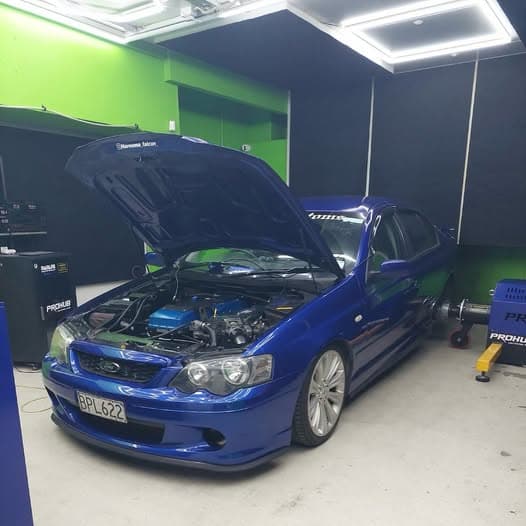
Not everything that rolls onto our dyno has an ECU. Classic cars, hot rods, and race builds with carburetors need a different approach to tuning - but the dyno is just as valuable.
Why dyno tune a carburated engine?
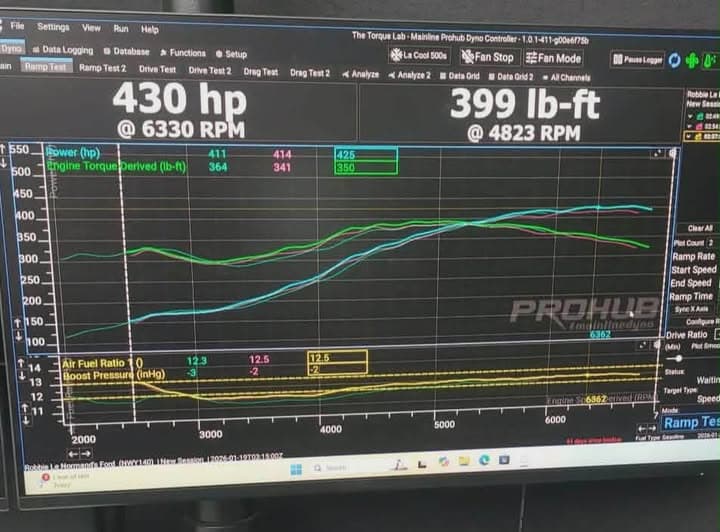
A dynamometer gives you something you can't get from road tuning: repeatable, controlled conditions with real-time data. When you're jetting a carburettor, you need to see exactly what the air/fuel ratio is doing at every RPM point - idle, cruise, part-throttle, and wide open.
Without a dyno, you're relying on spark plug colour and seat-of-the-pants feel. With a dyno and wideband O2 sensor, you can see the exact air/fuel ratio in real time and make precise jet changes to dial it in.
What we tune
We tune all types of carburetors on the dyno:
- Weber DCOE and DCNF - the classic choice for Japanese and European performance. We tune 40s, 45s, and 48s with proper jet selection, accelerator pump tuning, and emulsion tube matching.
- Holley - four-barrel and double pumper setups on V8s. Power valve selection, jet tuning, and accelerator pump adjustment.
- SU and Stromberg - common on British classics. Needle profiling and dashpot tuning for smooth throttle response.
- Mikuni and Solex - Japanese and European applications.
The tuning process
Carburettor tuning on the dyno typically follows this process:
- Baseline run - we run the engine at wide-open throttle and record air/fuel ratios across the rev range
- Main jet selection - adjusting the main jets to achieve the target air/fuel ratio at full load (typically 12.5-13.0:1 for performance, 12.0:1 for forced induction)
- Idle and transition - dialling in idle jets, mixture screws, and progression holes for smooth off-idle response
- Accelerator pump - tuning the pump shot for clean throttle tip-in without a flat spot
- Verification runs - final power pulls to confirm the tune is safe and consistent
Hub dyno advantage for classics
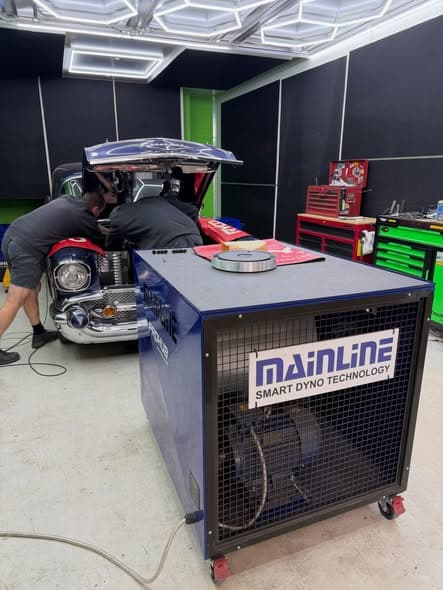
Many classic cars have limited tyre options or non-standard wheel sizes that don't sit well on roller dynos. Our Mainline hub dyno connects directly to the wheel hubs, so tyre size and condition don't affect the results. This makes it ideal for classic car tuning.
If you've got a carburated engine that needs tuning - whether it's a street cruiser or a race car - bring it in. We'll put it on the dyno and get it running right.